I think everyone knows at least one story that’s “somewhere in the Bible.” Noah’s Ark (Genesis Ch. 6), Jonah getting eaten by a whale (Jonah Ch. 2), David and Goliath ( 1 Samuel Ch. 17), and of course the stories of Jesus in the Gospels. The Bible is quite the book and can be difficult to read. I want to try and break it down for you guys.
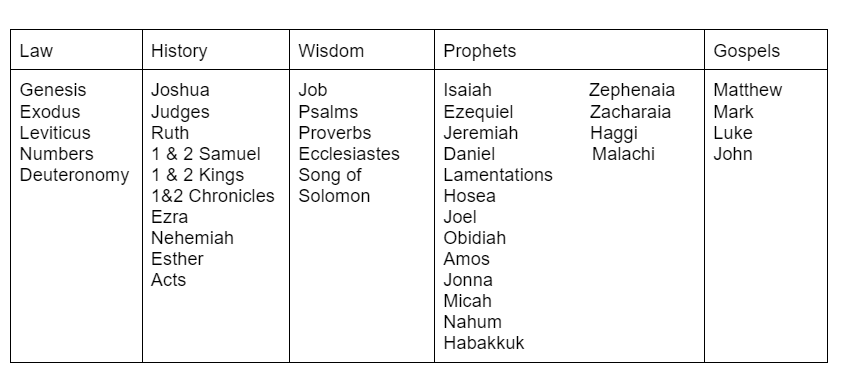
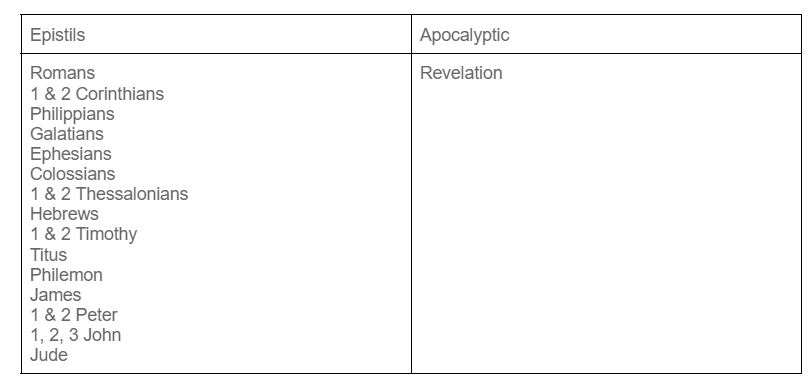
The Bible is not simply a book. It is a collection of books, 66 to be exact, with 40 different authors, written in different time periods and places, written in 3 different languages, with one central message. That message is “How God saves humanity from sin.” The Bible is divided into two major parts. The Old Testament (OT) and The New Testament (NT). You probably already knew that but, the books in the OT and NT also have different subsections within them. Understanding that is an important part of understanding what you’re reading. Now I won’t go through every book of the Bible. But I want to break down some sections and give a broad overview of them. I’ve also created a table at the bottom of this blog to give a better visual.
The Old Testament: This major section of the Bible tells the story of how God created the first human beings. Eventually, it led to the creation of the nation of Israel through Abraham. The OT has a lot of history of the nation of Israel. It’s the story of God’s relationship with that nation. But that’s not all. There are books of wisdom, prophecy, and law.
The Books of the Law: Also known as the Torah. The Torah is composed of the first five books of the Bible Genesis, Exodus, Numbers, Leviticus, and Deuteronomy. In these, you can find the story of creation to when the Israelites are about to enter the promised land. What is also in here is the Levitical law that was given to the people of Israel by Moses. These laws were meant to set Israel apart from the other nations of that time. You can read more about them in Exodus, Leviticus, and Deuteronomy.
The Historical Books: These are what you think they are… History. They mainly tell the story of the people of Israel and their relationship with God. Here we can find how Israel became a kingdom, some of the wars that took place, stories about the different kings of Israel, how the Israelites were eventually exiled to Babylon, what happened after Jesus ascended into heaven (this part is in the NT), etc. There are some wild stories in these books!
The Prophetic Books: These go hand in hand with the historical books, during the period when Israel had kings. A lot of them (most of them) began to rebel against God and disobey him. So God would try to correct them by sending different prophets to speak to the people on his behalf. There were major and minor prophets. Each prophet came with a similar but different message. They would also prophesy about many things to come. For example, they described what would happen to the kingdom of Israel if they continued to disobey God. The answer was exile. Check out the book of Daniel. More importantly, they would prophesy about the coming Messiah (Jesus) who would save the world.
The Books of Wisdom: These books are mainly poetry but there is a lot of wisdom within the poetry. These were written by King David, King Solomon, and many others. They describe how they processed the joy, sadness, anger, disappointment, and other emotions they had towards God. These books also share the wisdom that Solomen gained throughout his life. There is a lot of advice here on how to live a Godly life in these books.
The New Testament: So after the last book of the Old Testament Malachi, God seems to have gone silent. Four hundred years go by until John the Baptist shows up to break the silence. In his words ( and the prophet Isaiah) he came to prepare the way for Jesus. In the New Testament, we have the historical accounts of Jesus, the acts of the apostles (historical book), the epistles, and the Book of Revelation.
The Gospels: The four Gospels of Matthew, Mark, Luke, and John are the eyewitness accounts of Jesus’ three-year ministry here on earth. Here you can find what Jesus taught, the miracles he performed, his death, and resurrection. If you want to learn about Jesus, these are the books to start with.
Epistils: After the ascension of Jesus, his followers started spreading the good news across the known world. Christianity exploded. Churches started popping up in different places. Since following Jesus was a new way of life for most people at the time… they needed some guidance. The Epistles are letters written by Jesus’ followers to the different churches and people groups. The apostle Paul wrote a good portion of them. They contain guidance on how to live out faith in Christ.
Book of Revelation: I put this book in its own category because this book is different from the other ones. The genre of this book is known as “apocalyptic literature.” That means that the text is highly symbolic. There are many different ways that people interpret what is in this book. It describes events to come culminating with the return of Jesus to rescue his people. While this book has a lot of interpretive challenges, I think one thing is clear. God wins in the end.
I know that was a lot, but it’s important to keep these things in mind when you’re reading the Bible. You can’t read a Psalm the same way you read a historical book. Context is important when trying to interpret anything not just the Bible. Knowing what you’re reading, who the characters are, and what was happening at that time are incredibly important details to consider when trying to understand the Bible. If you run into a verse or passage that rubs you the wrong way, try to consider the following: What book am I reading? Who is it being written to? What was going on at that time? I believe this will begin to help you and me understand difficult passages better. I hope this was helpful!
 Apologetic Marketplace